
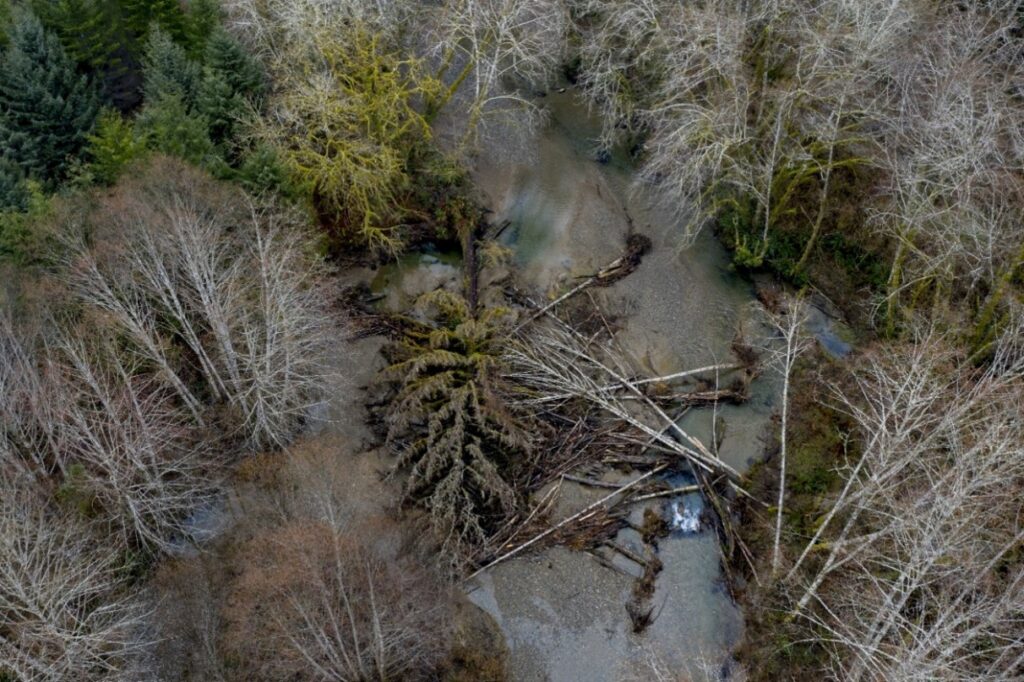
Beginning September 2026, 62 engineered log jams (ELJs) will be installed by helicopter along 2.5 miles of the Little Hoko River. This project will help restore approximately ~195 acres of coastal wetlands and riparian buffers on Washington State Park property, as a part of the broader effort to rehabilitate critical salmon habitats and wetland ecological function within the Hoko River watershed. Salmon serve as keystones of watershed health, directly or indirectly supporting more than 137 wildlife species in the Pacific Northwest.
 |
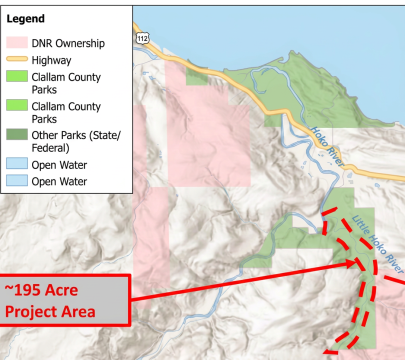 |
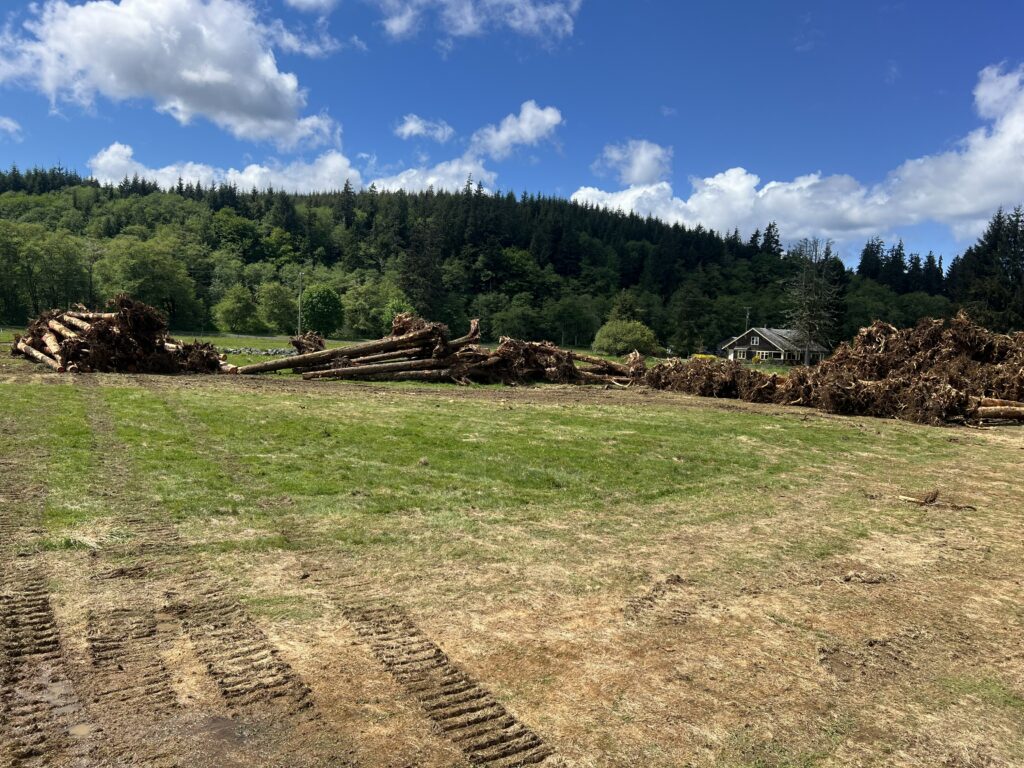
| Materials staged at Cowan Ranch (left) that will be placed by helicopter Fall 2026 throughout the 195 acre project area (right). | |
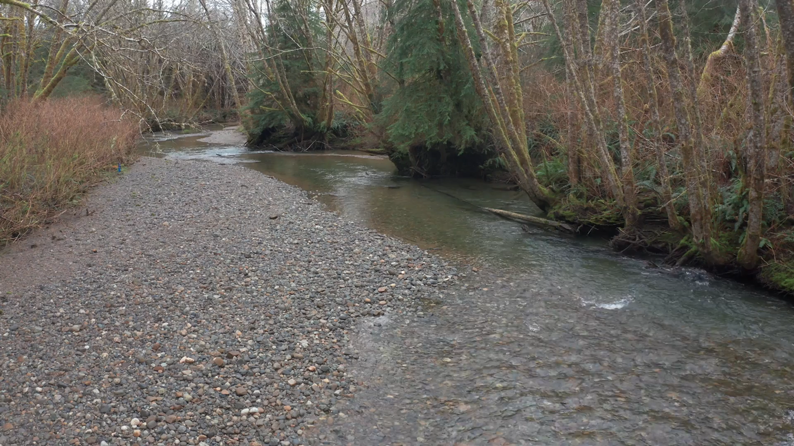
Prior land use practices, including industrial-scale logging and cattle grazing, left the Little Hoko River deeply incised. This legacy stripped the corridor of large-diameter trees and severed natural floodplain connections, significantly degrading fish habitat. Following Washington State Parks’ 1994 acquisition, initial rehabilitation focused on terminating grazing, establishing riparian buffers, and some early wood placement in the river. While 2024 observations show successful sediment retention and a recovering forest, the reach requires further intervention to address a chronic lack of large wood.
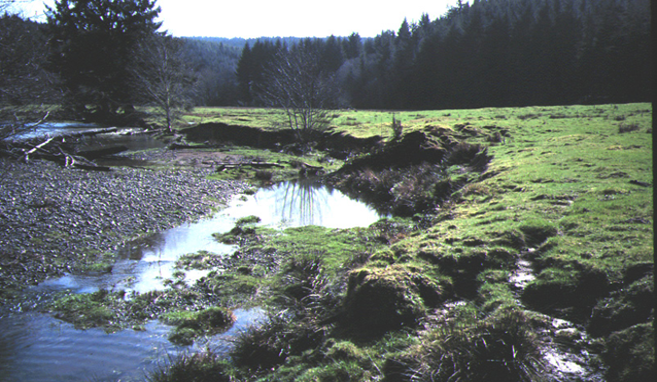
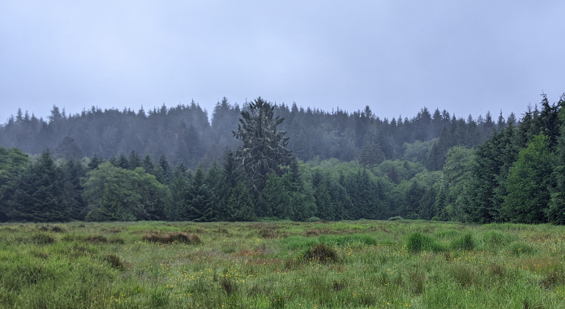
Since it will take several hundred years for the developing riparian forests to reach maturity and provide a natural supply of large wood, additional measures are necessary. This project involves the installation of engineered logjams designed to stabilize the riverbed, create deep pools, and increase floodplain connectivity. These structures will maintain essential habitat processes and capture debris carried downstream until the riparian zone becomes self-sufficient.
Recovery Goals
- Restore habitat for anadromous fishes
- Gradually collect wood and sediment, helping reverse incision, restore river grade and retain stable beds of small gravel suitable for spawning salmon, steelhead and Pacific lamprey
- Provide cover and divert water flow to create deep pools, providing refuge for migrating adult and juvenile fish
- Activate side channels to expand and diversify low-velocity rearing areas
- Promote watershed climate resilience
- Enhance groundwater recharge and strengthen surface-groundwater interactions, which introduces cooler water into the river system
- Mitigate erosion and habitat disturbances caused by increased flooding event frequency through the restoration of natural sedimentation, wood deposition, and riparian vegetation
Approach
Engineered logjams are an intermediate step to address the chronic loss of large diameter trees from the river associated with prior land use practices. Engineered logjams are designed to naturally become part of the landscape by using natural materials and by collecting fluvial wood and sediment to help rebuild river grade, reverse incision and reconnect lost floodplain wetlands. 62 ELJs will be installed along the 2.5 mile reach directly upstream from the confluence with the mainstem Hoko.
For more information on how ELJs are installed by helicopter on a remote river reach, check out this article and video of a similar project on the Pilchuck River.
Funding provided by
U.S. Fish and Wildlife Service
National Oceanic and Atmospheric Administration
Salmon Recovery Funding Board
Questions about the project?
Contact LEKT.HabitatRestoration@elwha.org